
Stephens County Court Records After Arrest
The arrest-to-court path in Stephens County has three record systems. The first is the jail booking record, which appears on the Interop roster when a person is booked into Stephens County Jail. The second is the prosecutor filing decision, which can confirm, change, reduce, dismiss, or replace the arrest charge. The third is the clerk or court record, which tracks the filed case, hearings, bond conditions, docket activity, and disposition.
The Stephens County Interop roster is still useful at the start because it gives the defendant name, arrest date, arresting agency, statute, charge description, warrant number when present, total bond, and per-charge bond amounts. For custody and booking detail, use Stephens County jail inmate records. For booking photos, use the Stephens County jail mugshots page. The court record itself is a separate track.
From Jail Arrest to Court Records
A Stephens County arrest usually starts with law enforcement custody, transport to the Stephens County Law Enforcement Center, booking, and entry of arrest data into the roster. The Justice of the Peace page states that Judge Steve Spoon performs magistrate functions. A magistrate can advise rights and address early probable cause or bond issues. Prosecutors then decide what charge to pursue, and the case record is handled through the proper court or clerk route.
- Check the Interop roster for the booking charge, arrest date, arresting agency, bond, and any warrant number.
- Identify whether the matter looks like a JP, county-level misdemeanor, district felony, or prosecutor-review issue.
- Use official court docket pages or clerk contact channels to look for scheduled appearances.
- Contact the District Clerk for district criminal records and felony case routing.
- Use the County Attorney for county-level prosecution questions and the District Attorney page for felony prosecution context.
- Treat the jail roster charge as preliminary until the court record confirms the filed charge and status.
The official Justice of the Peace page explains magistrate and misdemeanor functions and is part of the arrest-to-court route. The screenshot came from the Stephens County Justice of the Peace page.
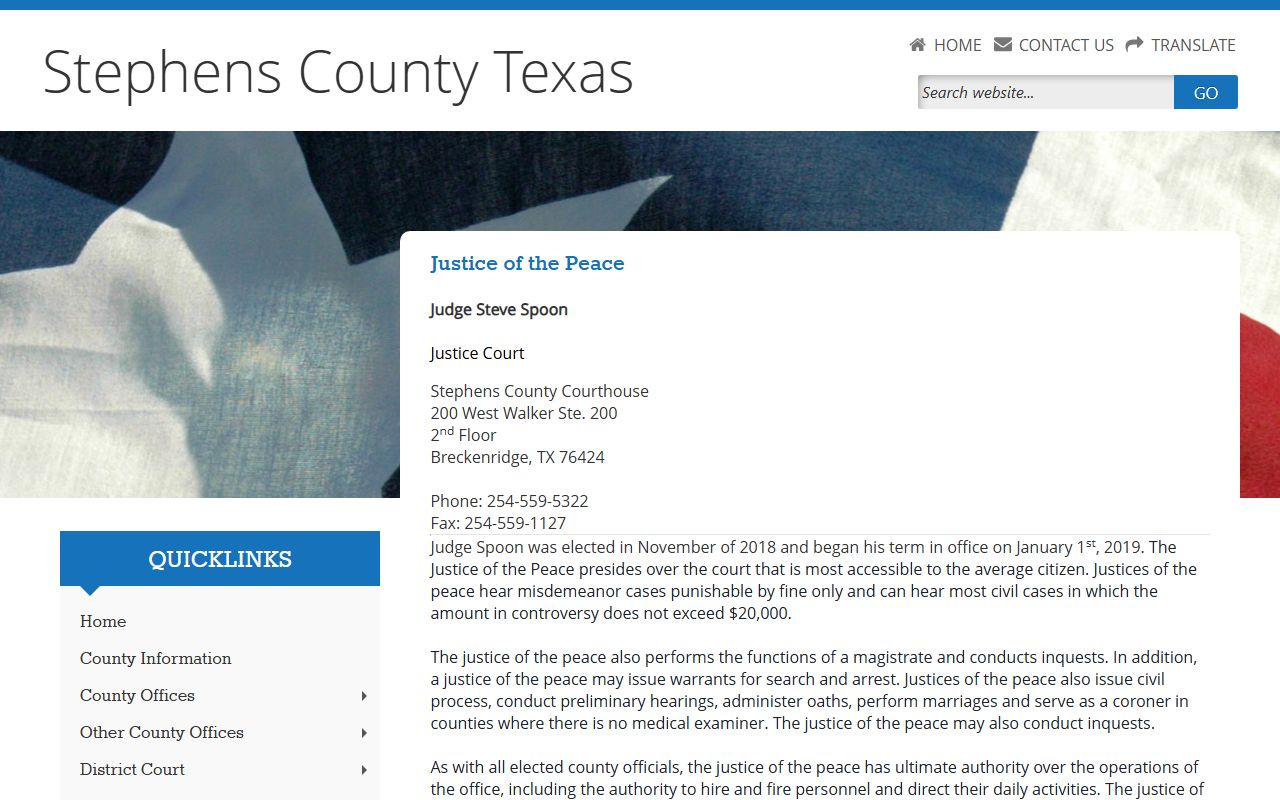
The local JP context matters because first appearances and magistrate functions occur before many users know which clerk or prosecutor will handle the filed case.
Find Stephens County Court Records After Arrest
No complete public criminal case-search form with a captured field set was located in the county pages reviewed. Stephens County does publish official office pages, court docket pages, and clerk contacts. That means the practical lookup method is a chain: start with the roster, move to official dockets or clerk contacts, then contact the prosecutor route if the charge is still under review.
| Office or Source | Role After Arrest | Published Contact Detail |
|---|---|---|
| District Clerk | District and felony criminal record contact. | Stephanie Elder, 200 West Walker, 254-559-3151. |
| County Attorney | County-level prosecution context. | Gary Trammel, Suite 206, 254-559-9091. |
| District Attorney | Felony prosecution context. | Dee Hudson Peavy, courthouse location; direct phone not found. |
| Justice of the Peace | Magistrate and fine-only misdemeanor functions. | Judge Steve Spoon, Suite 200, 254-559-5322. |
| County Court Dockets | County court scheduled appearances. | Official county docket page. |
| District Court Dockets | District court scheduled appearances. | Official district docket page. |
Charging Documents After Arrest
A jail arrest does not always produce a final court charge in the same form listed at booking. Prosecutors can file, amend, reduce, or decline charges. The court record after a jail arrest usually turns on the charging document and the court with jurisdiction. Texas criminal practice can involve complaints, informations, and indictments, depending on charge level and procedure.
| Document | Plain Meaning | Why It Matters |
|---|---|---|
| Complaint | A sworn accusation or charging statement. | Can begin or support a criminal case or magistrate process. |
| Information | A prosecutor-filed charging document. | Often used for misdemeanor prosecution and some procedural settings. |
| Indictment | A grand-jury charging document. | Common for felony charges that proceed through district court. |
Stephens County Charge Status
Charge status is the reason a booking result and a court result may not match. The roster can show an arrest charge and bond. The court record can later show a formal charge, amended language, a reduced charge, dismissal, deferred result, plea, trial setting, or conviction. Status words should be read as case-stage terms, not as proof of guilt by themselves.
| Status | What It Means | Reader Caution |
|---|---|---|
| Pending | The case or charge is still open. | Check the next docket setting and bond conditions. |
| Amended | The filed charge text, level, or count changed. | Do not rely only on the original roster wording. |
| Reduced | The charge was lowered to a lesser level or offense. | Confirm the current charge with the clerk record. |
| Dismissed | The court case or count was ended without conviction on that charge. | A dismissal is not the same thing as automatic expunction. |
| Convicted | A plea or finding resulted in conviction. | Sentenced custody may move to TDCJ or another system. |
Bond After a Stephens County Arrest
The Stephens roster publishes Total Bond and per-charge Bond Amount rows. Values observed in the research included dollar amounts, NOT SET, and DENIED. A not-set bond can mean the amount has not yet been entered or the case is waiting on magistrate or court action. A denied status or no-bond situation needs confirmation from the jail or court.
Texas release terms may include cash bond, surety bond through a bail bond company, personal recognizance or PR bond, and no-bond holds. Even when one charge shows a bond amount, another hold may block release. Examples include a bench warrant, parole or blue-warrant issue, out-of-county hold, federal hold, immigration detainer, or TDCJ transfer status. Call the jail at 254-559-2705 before trying to post bond.
- First appearance
- Early magistrate review after arrest, often tied to rights, probable cause, and bond.
- Bench warrant
- A court-issued warrant, often from missed court or violation of a court order.
- Detainer
- A request or hold from another agency that can affect release.
- Disposition
- The final court result, such as dismissal, conviction, acquittal, or deferred outcome.
Warrants and Court Records After Arrest
No official Stephens County sheriff active-warrant search page was located. The roster can still show warrant information after booking because charge rows include a Warrant# field, and the research found bench-warrant descriptions in sample entries. That means warrant information may appear once a person is in custody, but it does not prove there is a public active-warrant database for people not yet booked.
Warrant-related routes include the sheriff or jail for custody questions, the Justice of the Peace for magistrate and lower-court context, the District Clerk for district court records, the County Attorney for county-level prosecution, and the District Attorney page for felony prosecution routing. A Chapter 552 public information request may be appropriate for some records, but active investigations and law-enforcement exceptions can limit release.
Charges vs Convictions
A charge is an accusation in the arrest or court process. A conviction is a later court result. Stephens County court records after an arrest should be read with that distinction in mind because a roster charge can be amended, reduced, dismissed, or replaced after prosecutor review.
| Issue | Charge | Conviction |
|---|---|---|
| Case stage | Accusation or filed count. | Final result after plea, trial, or other judgment. |
| What it proves | That an allegation or filed charge exists. | That the court entered a conviction result. |
| Where it appears | Roster, charging document, docket, or clerk record. | Judgment, docket, criminal history, or sentencing record. |
Sealed vs Expunged Arrest Records
Texas law separates public access from later record clearing. The Texas Public Information Act starts with public access rules, but criminal records can also be affected by expunction, nondisclosure, juvenile rules, court orders, and law-enforcement exceptions. Texas Code of Criminal Procedure Chapter 55 governs expunction for eligible arrests and cases. Texas Government Code Chapter 411 addresses criminal history record information.
| Record Result | Plain Meaning | Stephens County Search Impact |
|---|---|---|
| Sealed or nondisclosed | Public access is restricted by court order or law. | A public search may not show the full record. |
| Expunged | Eligible records are removed or destroyed under Chapter 55 procedures. | Official agencies may no longer release the same arrest record. |
| Dismissed but not cleared | The charge ended, but record-clearing may not have occurred. | The case may still appear unless a separate order applies. |
Criminal History and FCRA Limits
Government Code Chapter 411 is the Texas criminal history framework. A public roster or clerk lookup is not the same as a regulated background check. Employers, landlords, insurers, lenders, and other decision makers must use legally compliant sources and processes when the Fair Credit Reporting Act or other screening laws apply.
Important: Court and jail lookups are not consumer reports and should not be used for FCRA-covered decisions.